How to Fix Stunted Hair Growth (What’s Actually Blocking Your Length)
Your hair grows roughly six inches every single year. So if yours has been sitting at the same length for months, the follicles almost certainly aren’t the problem. The real culprit is retention, and that’s a much easier fix.
Stunted hair growth feels invisible. You trim, you condition, you wait, and the length just doesn’t come. That frustration is real, and it’s completely solvable. This article walks you through the real causes of hair stagnation and the exact fixes, ordered from most impactful to least, that dermatologists and clinical studies actually support.
Your Hair Growth Roadmap
- Most stunted growth is a retention problem, not a follicle problem
- Scalp health, diet, and breakage prevention fix more than any single product
- Most people see measurable improvement within 3 to 6 months of addressing root causes
- A 2015 randomized controlled trial found rosemary oil matched minoxidil 2% for hair count at 6 months
What Does Stunted Hair Growth Actually Mean?
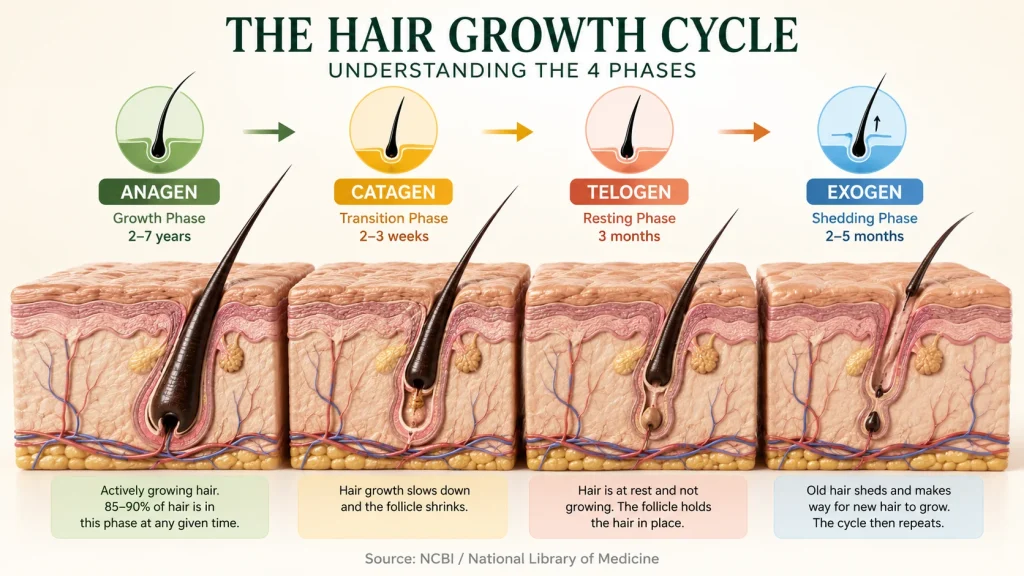
Stunted hair growth means your hair appears not to get longer despite still cycling through the growth phases. Your follicles are almost always still active. The issue is retention, not production. Most people’s hair IS growing at the root. The problem is that it’s breaking off at the ends at roughly the same rate.
Here’s what that means in practice. If you’re shedding short pieces with no white bulb at the tip, that’s breakage, not shedding. True shedding includes the root bulb. Breakage comes from the ends. The signs of stunted growth are: the same length for three or more months, uneven wispy ends, and lots of short broken pieces on your brush.
Hair grows approximately 0.5 inches per month on average, according to NCBI. If you’re not gaining length, something is interrupting retention, not growth.
What Causes Stunted Hair Growth?
The most common culprits are breakage from heat or manipulation, nutritional gaps in iron and protein, chronic stress pushing follicles into their resting phase too early, scalp congestion blocking follicle openings, and hormonal factors like DHT sensitivity. Most people have two or three of these overlapping at once.
Breakage Masking Growth
Heat damage, chemical treatments, tight hairstyles, and rough handling are the most common cause of stagnant length. Your hair grows 0.5 inches per month, but if it’s breaking 0.5 inches off at the ends, your net length gain is zero. This is the easiest cause to fix once you identify it.
Nutritional Deficiencies
Iron deficiency is the leading nutritional cause of stunted hair growth in women. Hair is made of keratin, a protein, so low protein intake directly weakens the strand. Zinc, Vitamin D, and biotin round out the key nutrient stack, though biotin only makes a visible difference if you’re genuinely deficient.




Chronic Stress and Telogen Effluvium
Cortisol spikes push follicles from the growth phase into the resting phase too early. The tricky part: the shedding appears two to three months AFTER the stress event, which makes it hard to connect cause and effect. Telogen effluvium is clinically diagnosed when daily hair loss exceeds 125 strands, according to the National Library of Medicine.
Scalp Congestion
Product buildup, excess sebum, and pollutants can physically block follicle openings. An inflamed or congested scalp also delivers less oxygen and fewer nutrients to the root. The fix is straightforward: a clarifying shampoo every four to six weeks.
Hormonal and Genetic Factors
DHT shrinks follicles and shortens the anagen phase over time, leading to finer, shorter strands. Thyroid disorders, whether hypo or hyper, directly disrupt the growth cycle. Age naturally shortens anagen duration. These require medical support but are important to know about when other fixes aren’t working.
How to Fix Stunted Hair Growth: 8 Steps That Actually Work
Fixing stunted growth means doing two things at once: removing whatever is blocking the follicle and stopping the breakage that erases your gains. These 8 steps address both sides of the equation internal nutrition, scalp environment, and protective habits.
Step 1: Diagnose Your Real Problem First
Before buying products, identify whether the issue is breakage, diet, scalp health, or hormonal. Run your fingers through freshly washed hair. Lots of short pieces with no white root bulb means a retention problem. Hair with the white bulb attached is normal shedding. The fix is completely different depending on which you have.
Step 2: Fix Your Diet Iron and Protein First
Iron deficiency is the number one nutritional cause of stunted growth in women. Hair is made of keratin, and keratin is a protein, so under-eating protein weakens every strand you have. Start with food sources before supplements: eggs, lentils, leafy greens, fatty fish, pumpkin seeds, and lean meat. Low ferritin levels are directly associated with chronic telogen effluvium, according to the AAD.
Step 3: Scalp Massage (4 to 5 Minutes, 3 to 4 Times Per Week)
Scalp massage increases blood flow, which delivers more nutrients to the follicle root. Use your fingertips only, in a firm circular motion. Don’t scratch. A 2016 standardized study by Koyama et al. published in ePlasty found that 24 weeks of consistent scalp massage increased hair thickness in participants. Four minutes daily is enough to see results over time.
Step 4: Try Rosemary Oil (With Realistic Expectations)

A 2015 randomized controlled trial by Panahi et al., published in SKINmed Journal, found that rosemary oil matched minoxidil 2% for hair count after six months, with less scalp itching reported in the rosemary group. Here’s the honest caveat: at three months, there was no significant difference between the groups. Results appear at month six. Do not quit early.
How to use it: dilute rosemary essential oil in a carrier oil like jojoba or castor oil, apply to the scalp three to four times per week, and massage it in. Never apply undiluted essential oil directly to the scalp.
| Feature | Rosemary Oil | Minoxidil 2% |
|---|---|---|
| Evidence Level | RCT (Panahi et al., 2015) | Multiple clinical trials |
| Results Timeline | Significant at 6 months | 3–6 months |
| Side Effects | Minimal (mild scalp tingling) | Scalp irritation, dryness |
| Cost | Low (one bottle, many uses) | Moderate (ongoing) |
| Best For | Early-stage thinning, natural preference | Androgenetic alopecia |
Citation Capsule: A 2015 randomized trial (Panahi et al., SKINmed Journal) compared rosemary oil to minoxidil 2% in 100 patients over 6 months. Both groups showed equivalent hair count increases at the 6-month mark. The rosemary group reported less scalp itching. Zero significant difference was found at 3 months in either group. (SKINmed Journal, 2015)
Step 5: Stop the Breakage Cycle
If your hair grows six inches per year but breaks five inches off, you gain one inch of net length. That’s not slow growth. That’s a retention crisis. Switch to a satin pillowcase or use a hair bonnet at night. Use a wide-tooth comb only on wet, conditioned hair. Reduce heat styling, and when you do use heat, a heat protectant is non-negotiable. Deep condition once per week with a focus on moisture and protein balance.
Step 6: Clarify Your Scalp Every 4 to 6 Weeks
Buildup physically blocks new growth from emerging from the follicle. Use a gentle clarifying shampoo or a diluted apple cider vinegar rinse every four to six weeks. One warning: don’t over-clarify. Stripping the scalp of its natural oils causes dryness, which leads to more breakage. Once a month is plenty for most hair types.
Step 7: Manage Cortisol (The Most Underrated Fix)
Most hair articles mention stress once and move on. This step deserves more. Consistent sleep, regular movement, and reducing chronic overload are not optional lifestyle upgrades for hair. They’re biological requirements for keeping follicles in the growth phase. Ashwagandha has some clinical support for cortisol reduction. The key thing to remember: stress-triggered shedding shows up two to three months after the stress event, not immediately.
Step 8: Get Blood Work If Nothing Else Works
I tried every topical fix for six months with minimal improvement, and it turned out my ferritin was sitting at 11 ng/mL, the low end of “normal” but far below the threshold most hair specialists consider optimal (above 70 ng/mL). One targeted supplement protocol changed everything within four months.
If six months of steps one through seven shows no improvement, rule out subclinical causes. Ask your doctor to test ferritin (iron stores), TSH (thyroid), Vitamin D, and DHEA. Many cases of unexplained stunted growth trace directly back to low ferritin. This is the step almost no hair article gives you.
How Long Does It Take to See Results?
Most people see measurable improvement within 3 to 6 months when root causes are genuinely addressed. Hair biology is slow and there are no shortcuts, only conditions you create for growth to happen. The timeline is predictable once you commit to the process.
Here’s what to expect at each stage:
- Month 1 to 2: Reduced shedding, scalp feels cleaner and less inflamed
- Month 3 to 4: Baby hairs appearing at the hairline, existing strands feel stronger
- Month 6+: Visible length gain and measurable density improvement
Why three months is too early to judge: in the Panahi 2015 rosemary vs. minoxidil study, neither group showed significant hair count improvement at the three-month mark. Both groups showed significant increases at six months. Patience is not optional. It’s part of the protocol. The biology simply takes that long.
Signs Your Hair Is Growing (Even When You Can’t See It Yet)
If you’ve started the fixes above, here are the early indicators that the process is working, before you see any visible length change. These signs matter because they confirm the biology is moving in the right direction.
Look for these signals in the first 8 to 12 weeks:
- Less hair in the drain and on your brush retention is improving
- Scalp feels less itchy or flaky, congestion is clearing
- Ends feel less brittle or rough, breakage is reducing
- Baby hairs appearing at the temples or hairline, new anagen cycles are starting
- Hair feels different in texture before any length change appears, strand health is improving first
Growth and retention always happen before length. Your hair doesn’t show the work right away. If you’re seeing these signs, the process is already working. Trust the biology.
When Should You See a Dermatologist?
If you’ve followed steps one through eight consistently for six months and still see no change, it’s time for a clinical evaluation. Something systemic may be at play that topical fixes cannot address. The American Academy of Dermatology recommends seeking professional review for persistent hair loss that doesn’t respond to self-care.
Don’t wait six months if you notice any of these red flags:
- Sudden, patchy, or circular hair loss possible alopecia areata
- Scalp irritation, scaling, redness, or lesions
- Diffuse thinning across the entire scalp, not just the ends
- Hair loss following a major illness, surgery, childbirth, or extreme stress event
- Thinning at the temples with no other explanation
A dermatologist can run a ferritin panel, TSH test, androgen levels, and perform trichoscopy (scalp visualization under magnification) to identify what no topical treatment will fix. Getting blood work is not a last resort. It’s a smart escalation when six months of consistent effort hasn’t moved the needle.
Frequently Asked Questions
Can stunted hair growth be permanent?
Rarely. Unless follicles are scarred from traction alopecia or severe ongoing inflammation, most cases are fully reversible once the underlying cause is removed. True permanent follicle loss requires a dermatologist to confirm via trichoscopy. The vast majority of stunted growth cases respond well once root causes like breakage, diet gaps, or scalp issues are genuinely addressed.
What vitamins help most with stunted hair growth?
Iron (specifically ferritin), Vitamin D, and zinc are the most clinically significant. Biotin is heavily marketed but only makes a visible difference if you’re actually deficient, which most people aren’t. Supplementing without testing first wastes money and misses the real issue. Get blood work before buying anything. Knowing your specific deficiency lets you target the right nutrient.
Does trimming help hair grow faster?
No. Trims don’t affect follicle activity at the root. But removing split ends prevents breakage from traveling up the hair shaft, which directly improves length retention. So trims don’t make hair grow faster, they help you keep what’s already growing. For most people with retention problems, a small trim every eight to twelve weeks is worthwhile.
Why does my hair grow but not get longer?
This is the breakage-masking-growth problem. Your follicles are producing hair at the root, but it’s snapping off at the ends at the same rate it grows. The net result looks like no growth at all. Fix the retention side of the equation, steps 3, 5, and 6 above not the growth side. The growth is already happening. The ends just can’t hold onto it.
How long does stunted hair growth take to fix?
Most people notice less shedding and stronger strands within 6 to 8 weeks. Baby hairs become visible in 3 to 4 months. Visible length gain typically appears by month 6, provided root causes are genuinely addressed rather than just patched with products. Consistency over that full six-month window is what determines results, not any single product or treatment.