You’re standing in front of the mirror, unsure if your curls are tight enough to be 3C or too loose to be 3A. Welcome to the 3B club. 3B curls are springy, well-defined ringlets about the width of a Sharpie marker. They sit in the middle of the Type 3 curly hair family and need a moisture-first routine to stay bouncy, defined, and frizz-free. This guide covers exactly how to identify your curl type, build a wash-day routine that works, and style your curls for maximum definition.
Your 3B Hair Roadmap
3B curls are springy ringlets about the width of a Sharpie, tighter than 3A and looser than 3C
Moisture is everything: natural sebum cannot travel down the spiral curl shaft easily
Wash 1 to 2 times per week and condition more often than you shampoo
The LOC method (Leave-in, Oil, Cream) builds and locks in moisture for defined curls all week
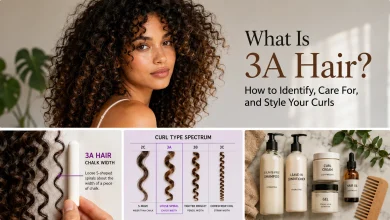
3B hair sits on the Andre Walker Hair Typing System as a mid-range curl within the Type 3 curly family. The curls form tight, well-defined ringlets from the root, not just the mid-shaft, with a circumference close to a Sharpie permanent marker. Volume is naturally high and shrinkage is real.
Hair typing was created by stylist Andre Walker in the 1990s and published in his 1997 book Andre Talks Hair. The system runs from 1A (straight) to 4C (tightly coiled). Type 3 covers all curly hair, and within that range, 3B is the middle ground. If your curls feel like corkscrews at the root and form ringlets that hold their shape without product, you’re likely looking at 3B.
Why do 3B curls form in the first place? It comes down to follicle shape. 3B hair grows from an elliptical or oval-shaped follicle. The more oval the follicle, the tighter the curl. The hair shaft itself is made of keratin protein, and the curl pattern is locked in by disulfide bonds inside the cortex. Those bonds determine whether your hair forms a wave, a ringlet, or a coil. Chemical relaxers and bleach break those bonds permanently, which is why heat or chemical damage changes the 3B pattern over time.
3B hair is typically fine to medium in strand thickness, but because there’s so much of it, the overall density feels high. It’s common to have a mix: 3A patches on top where the hair is looser, and 3C patches underneath where the curl is tighter. If you have 2C hair, the curls are looser and closer to waves. If your coils are tighter than a pencil width, you may be 4A. Most 3B heads carry at least two curl patterns, and that’s completely normal.
When I first started identifying my curl type, I kept jumping between 3A and 3C depending on how my hair dried. It took me three wash days to realise I was 3B with a 3C nape. Once I accepted the mix and stopped fighting it with one-size-fits-all products, everything changed.
3A vs 3B vs 3C comparison: curl width, volume, frizz risk, porosity, and dryness level. 3B is highlighted as the focus type.
How Do You Know If You Have 3B Hair?
The simplest test: hold a single ringlet next to a Sharpie marker. If the curl circumference matches the barrel, you’re likely 3B. Back that up with the float test for porosity and check whether your curls form from the root. Those three signals together give a clear picture of your curl type.
The Marker Test
Take one dry ringlet and hold it next to a permanent marker barrel. 3B curls match the Sharpie. If your curl is looser and closer to the size of a marker cap, you may be 3A. If it is tighter than a pencil, you are probably 3C. The key is to test a curl from your dominant section, not an outlier strand near your nape or hairline where patterns often differ.
Hair Porosity: Run the Float Test
Hair porosity tells you how open or closed your cuticle layer is, and it affects everything from product choice to frizz levels. 3B hair most commonly skews toward high porosity, but not always.
To do the float test: take a clean strand of shed hair and drop it into a glass of room-temperature water. Wait 2 to 4 minutes.
Strand sinks quickly: high porosity. The cuticle is open and water rushes in fast. This also means moisture escapes fast.
Strand floats: low porosity. The cuticle is tight. Products sit on the hair rather than absorbing.
Strand hovers in the middle: medium porosity. The ideal state.
High porosity 3B hair needs protein treatments and heavy sealants to slow moisture loss. Low porosity 3B hair needs lightweight water-based products and heat to open the cuticle during conditioning. Knowing your porosity prevents you from layering on products that are actively working against your hair.
Shrinkage Is Normal, Not Damage
3B curls can shrink 30 to 50 percent as they dry. If your hair looks much shorter dry than wet, that is shrinkage, not breakage. It is one of the most common sources of confusion for people new to their curl type. The tighter the curl pattern, the more shrinkage you will see. Shrinkage actually signals healthy, elastic curls.
Density vs Curl Type
Curl type and hair density are two different things. 3B refers to your curl pattern, not how many strands grow per square centimetre. You can have 3B curls with fine strands and low density, or 3B curls with thick strands and very high density. Understanding both helps you choose the right product weight. Fine, high-density 3B hair gets weighed down by heavy creams. Thick, low-density 3B hair can handle richer formulas.
The 3B Hair Care Routine (Step by Step)
3B hair needs a moisture-first routine where every step either adds or locks in hydration. Wash 1 to 2 times per week with a sulfate-free shampoo, deep condition weekly, and apply the LOC method on soaking-wet hair immediately after the shower. That sequence covers the foundation.
Full Wash Day Routine
Step
What to Do
Key Ingredients to Look For
Pre-poo (optional)
Apply coconut oil or conditioner 30 min before washing to protect strands from shampoo stripping
Coconut oil, olive oil, argan oil
Shampoo
Sulfate-free only, 1 to 2 times per week; use clarifying shampoo once a month to clear buildup
No SLS, no SLES, no parabens
Condition
Rinse-out conditioner every wash; deep condition weekly with a hair mask
Shea butter, panthenol, aloe vera
Detangle
Wide-tooth comb or fingers on wet, conditioned hair only. Never on dry hair.
N/A
Squish to Condish
Cup hands and scrunch water and conditioner upward into curls to encourage clumping during rinse
N/A
LOC Method
Leave-in conditioner, then oil, then curl cream or gel. Apply to soaking-wet hair.
Lightweight, water-based leave-in; glycerin-free if climate is dry
Plopping
Flip wet hair onto a microfibre towel or T-shirt. Wrap and leave 10 to 20 minutes.
N/A
Drying
Air dry or diffuse on low heat with head flipped for volume
Heat protectant if diffusing
The LOC Method Explained
LOC stands for Leave-in conditioner, Oil, and Cream. The order matters because each layer has a specific job. The leave-in adds water-based moisture. The oil seals it in by coating the shaft. The cream or gel defines the curl and provides hold. Apply all three while your hair is still dripping. Curly Girl Method creator Lorraine Massey built this principle into CGM: wet application is what allows the curl to clump and dry with shape.
If your curls feel weighed down after LOC, try LCO instead, swapping the oil and cream steps. This works better for fine-stranded 3B hair that gets overwhelmed by heavy oils as the second layer.
Co-Washing and Clarifying
Co-washing means using conditioner only instead of shampoo. It is a core concept from the Curly Girl Method and keeps 3B hair from drying out on in-between wash days. Use it when your scalp is not excessively oily and your hair does not have noticeable buildup.
Product buildup is a real problem for 3B hair. Styling creams, gels, and leave-ins accumulate over weeks and flatten curls, cause dullness, and block moisture from entering the shaft. A clarifying shampoo used once a month strips that buildup without the need for harsh daily washing. If your water is hard (common across Pakistan and the MENA region), mineral deposits add to that buildup, making clarifying even more important. A vitamin C rinse or a shower filter can reduce the impact of hard water on your curl pattern.
Protein and Moisture Balance
3B hair needs both protein and moisture, but the balance matters. A protein treatment every 6 to 8 weeks strengthens the hair shaft and reduces breakage. However, too much protein makes curls stiff and brittle. Some 3B hair is also protein-sensitive, meaning it reacts poorly to hydrolyzed proteins like keratin or silk proteins. If your curls feel hard and snap easily after a protein treatment, reduce frequency and check ingredients. Moisture masks, on the other hand, should be weekly.
How to Style 3B Hair for Maximum Definition
The goal when styling 3B curls is to encourage curl clumping while avoiding frizz. Apply products immediately to soaking-wet hair, scrunch upward rather than raking through, and keep hands off while curls dry. That simple combination is responsible for most of the definition you see in well-styled 3B hair.
Wash and Go: The Most Popular 3B Style
The wash-and-go is exactly what it sounds like: wash, apply your LOC method products, plop for 15 minutes, and let your curls air dry or diffuse. No additional manipulation. For 3B hair, this produces the most natural, high-definition ringlets because you’re letting the curl pattern express itself without force. The trick is applying enough gel to create a light cast over the curls. That cast protects the curl shape while drying. Once fully dry, scrunch out the crunch (SOTC) to break the gel cast and reveal soft, defined curls underneath.
Diffusing vs Air Drying
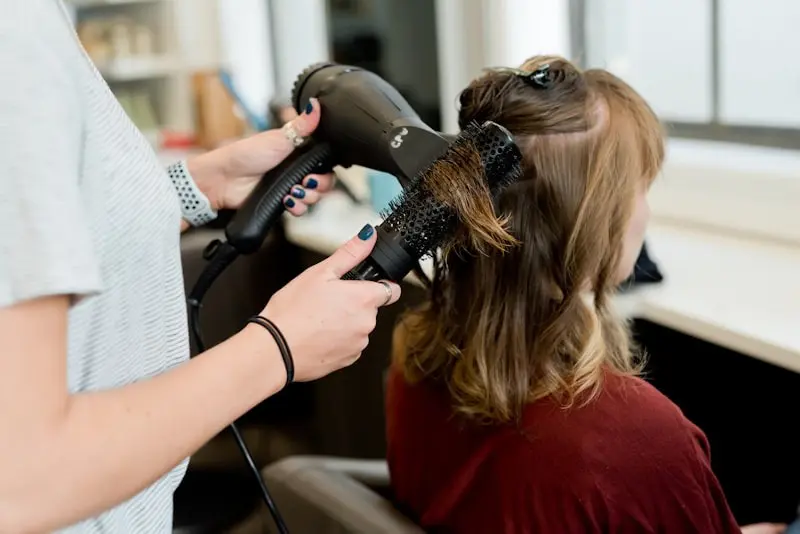
Air drying takes 2 to 4 hours for most 3B hair and produces the least frizz because there is no airflow disturbing the curl. Diffusing is faster and adds root volume, but you must use low heat and low airflow to avoid disrupting the curl clumps. Always apply a heat protectant before diffusing, even on the lowest setting. Flip your head upside down, cup sections of hair into the diffuser bowl, and hold in place for 30 to 60 seconds per section without moving.
Plopping: The Step Most People Skip
Plopping is a post-shower wrapping technique that removes excess water while keeping the curl shape intact. It is one of the highest-impact 3B techniques and one of the least followed.
How to plop:
Lay a microfibre towel or old cotton T-shirt flat on a surface
Flip your wet hair forward and lower it onto the centre of the cloth
Bring the bottom edge of the cloth up behind your neck
Tuck the sides in and secure at the top of your head
Leave for 10 to 20 minutes, then remove gently
The result is reduced drying time, less frizz, and better curl clumping, all without touching the curl pattern.
Twist-Outs and Braid-Outs
If you want a stretched, defined look with less shrinkage, twist-outs and braid-outs are excellent 3B styles. After applying your styling products, twist or braid sections while hair is damp. Leave overnight, then unravel in the morning. The result is elongated, defined texture with significantly less shrinkage than a wash-and-go. A Denman brush is a popular choice among 3B naturals for section-by-section detangling before twisting.
Humidity and Frizz: What Is Actually Happening
When the air is humid, the open cuticle layer of 3B hair absorbs moisture unevenly from the atmosphere. This causes the hair shaft to swell irregularly and the curl pattern to loosen and puff. The fix is not to fight humidity but to seal the cuticle before it opens. A good hold gel creates a barrier. Glycerin is a humectant that works well in humid climates because it pulls moisture from the air into the hair. In dry climates, however, glycerin pulls moisture out of the hair instead. If you live in a dry or arid region, check your products for glycerin and consider glycerin-free options in winter or during dry spells.
Common 3B Hair Mistakes (and How to Fix Them)
Even with the right products, small daily habits can wreck 3B curls consistently. The biggest culprits are brushing dry hair, using too much product, and touching curls while they dry. Fixing these habits is often more impactful than switching products.
3B Curl Commandments: What to Stop Doing
Brushing dry curls: Brushing on dry hair breaks the curl pattern and causes frizz. Detangle only on wet, conditioned hair with a wide-tooth comb or fingers.
Using too much product: 3B curls get weighed down by heavy butters and thick creams. Lightweight layering is more effective than loading product on.
Terry cloth towels: Cotton terry creates friction that disrupts the cuticle and causes frizz. Use microfibre or an old T-shirt instead.
Touching curls while they dry: Every touch breaks the curl clump. Apply products, plop, and leave the hair alone until fully dry.
Skipping deep conditioning: Weekly deep conditioning keeps the moisture-protein balance stable and prevents breakage from over-drying.
Overwashing: Washing more than twice a week strips the limited sebum that 3B curls depend on. The sebum cannot travel easily down the spiral shaft as it is, so what little exists needs to stay.
Ignoring product buildup: Buildup flattens curls and blocks moisture. If your curls feel heavy and limp after styling, a clarifying shampoo is the fix, not more conditioner.
Skipping a heat protectant before diffusing: Even low heat disrupts disulfide bonds over time and permanently alters the 3B pattern. A heat protectant is not optional.
Most curly hair content pushes product stacking as the answer to everything. With 3B hair, less is often more. The spiral curl pattern is physically dense, and heavy oils or thick butters sit on the outside of the curl rather than absorbing in. If your curls look frizzy and undefined despite using a lot of product, the problem may be product weight, not product quantity.
Best Product Types for 3B Hair
3B hair needs lightweight hydration, not heavy butters. The spiral curl pattern is too dense to absorb thick creams without losing definition and becoming limp. Focus on water-based leave-ins, penetrating oils like argan or coconut, and flexible-hold gels that define without crunch.
Products to Use
Product Type
Role in Routine
Best Ingredients
Sulfate-free shampoo
Cleanse without stripping moisture
No SLS, no SLES
Clarifying shampoo
Monthly reset to remove buildup
Mild chelating agents
Deep conditioner / hair mask
Weekly moisture treatment
Shea butter, panthenol, aloe vera, honey
Rinse-out conditioner
Slip for detangling every wash
Not too protein-heavy for sensitive hair
Leave-in conditioner
L in LOC method, water-based moisture
Aloe vera, panthenol, glycerin (climate check)
Lightweight oil
Seals moisture into shaft
Argan oil, jojoba oil, rosehip oil, coconut oil
Curl cream or lightweight gel
C in LOC, definition and hold
Flexible hold, no alcohol
Protein treatment
Monthly strengthening, not weekly
Hydrolyzed keratin, silk protein (watch for sensitivity)
Humectants vs Occlusives: Know the Difference
Humectants like glycerin and aloe vera attract moisture from the air into the hair shaft. Occlusives like oils and shea butter seal moisture in by coating the strand. 3B hair needs both in the right order: humectant first (leave-in), then occlusive (oil), then a light film-forming hold product (gel or cream). Using a heavy occlusive first blocks the humectant from reaching the shaft.
Ingredients to Avoid
Sodium lauryl sulfate (SLS) and sodium laureth sulfate (SLES): strip moisture and dry out the curl pattern
Non-water-soluble silicones (dimethicone, cyclopentasiloxane): coat the cuticle and cause buildup that blocks moisture
Drying alcohols (SD alcohol, isopropanol): evaporate and dehydrate the hair shaft
Mineral oil and petrolatum: heavy occlusives that create buildup without moisturising
Parabens: a preservative concern some curly hair users prefer to avoid
Look for CGM-approved or CG-friendly labelling as a shortcut. These labels indicate the product meets Curly Girl Method standards: no sulfates, no silicones, no drying alcohols.
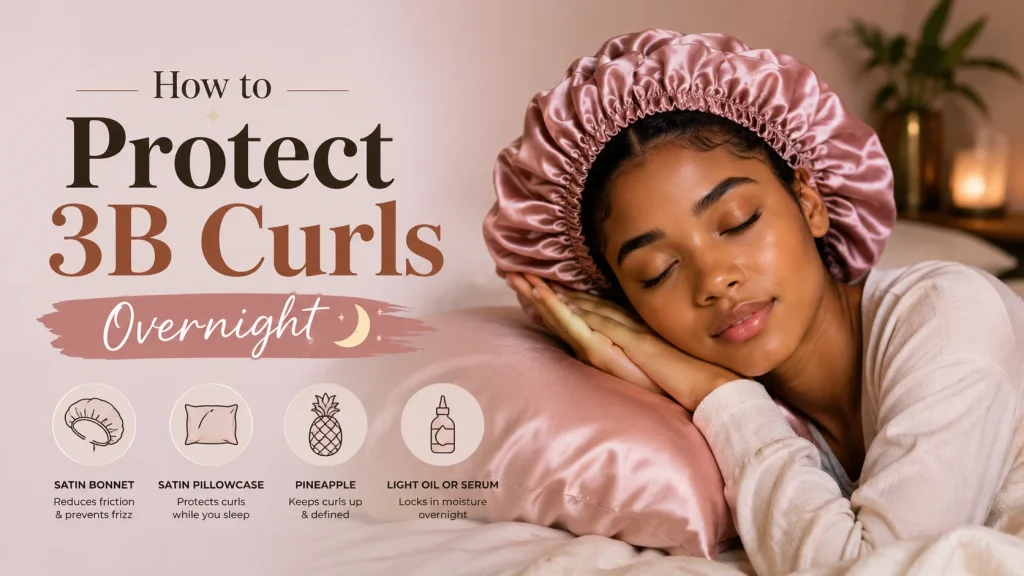
How to Protect 3B Curls Overnight
Nighttime protection is where 3B hair is either maintained or destroyed. Cotton pillowcases create friction that roughens the cuticle, causes frizz, and breaks curl clumps by morning. Two minutes of preparation before bed preserves up to three days of curl integrity without having to restyle from scratch.
The Pineapple Method
Pineappling means gathering all your curls loosely at the very top of your head using a soft scrunchie (not an elastic band, which causes breakage at the point of contact). The goal is to keep curls elevated and off your neck so they don’t compress while you sleep. Loose is the key word. A tight pineapple leaves a dent and flattens curls at the root.
Satin Pillowcase vs Silk Bonnet
Both work. A satin pillowcase reduces friction if you tend to remove a bonnet in your sleep. A silk or satin bonnet fully encloses the curls and keeps them compressed and protected. If your hair is on the longer or thicker side, a bonnet with more room (sometimes called a jumbo bonnet or sleep cap) works better than a standard size. A silk scarf is another option: wrap it around your head and tie at the front.
Refresh Days
Between wash days, revive curls with a curl refresh spray. Fill a small spray bottle with water and a small amount of leave-in conditioner. Mist the hair lightly, scrunch upward, and let it dry. Do not saturate the hair or you’ll reset the product layering you built on wash day. A small amount of curl cream or gel on stubborn sections is enough to revive definition without a full wash.
Frequently Asked Questions
How often should I wash 3B hair?
Wash 3B hair 1 to 2 times per week. Washing more often strips the natural oils your curls depend on. The sebum produced at the scalp struggles to travel down the spiral shaft, so it is already limited. Between washes, refresh with a water mist and a small amount of leave-in conditioner.
Is 3B hair high porosity?
Many 3B curls lean toward high porosity, meaning the hair cuticle is raised and absorbs water quickly but also loses moisture fast. However, some 3B hair is low porosity. Run the float test at home to find out your type before building your routine around a porosity assumption.
What is plopping and how do I do it for 3B hair?
Plopping is a drying technique where you wrap freshly washed, product-applied hair in a microfibre towel or cotton T-shirt. Lay the cloth flat, flip wet hair onto it, wrap the edges around your head, and leave for 10 to 20 minutes. It reduces frizz and encourages curl clumping.
Does 3B hair shrink when it dries?
Yes. 3B curls can shrink 30 to 50 percent as they dry. Many people mistake shrinkage for breakage or damage, but it is completely normal. Healthy, elastic curls shrink more. Stretching styles like twist-outs or braid-outs reduce visible shrinkage without heat damage to your curl pattern.
How do I stop 3B hair from frizzing in humidity?
Humidity frizz happens when the open hair cuticle absorbs moisture unevenly from the air. Apply styling products to very wet hair, avoid touching curls while they dry, use a strong hold gel to seal the cuticle, and sleep on a satin pillowcase every night to reduce morning frizz.
How do I know if I have 3B or 3C hair?
Hold a single ringlet next to a Sharpie marker and a pencil. If your curl matches the Sharpie width, you have 3B. If it is closer to a pencil width or tighter, you likely have 3C. Many heads carry a mix of both patterns across different sections.
Wrapping Up
3B curls are genuinely stunning when they get what they need: consistent moisture, the right product weight, and protection overnight. It takes a few wash days to dial in your routine, and that is completely normal. Start with the LOC method, run the float test to check your porosity, and add plopping if you haven’t already. Those three changes alone will visibly improve your curl definition.
Your 3B pattern is not a problem to solve. It is a curl type to understand. Once you do, the routine becomes less complicated, not more.