What Is 3C Hair Type? Everything You Need to Know About Your Curls
You’ve probably spent time in front of the mirror trying to figure out your curl pattern. Is it 3B? 3C? Somewhere in between? It’s a question almost everyone in the natural hair community asks at some point, and it matters more than you might think.
3C hair is a tight, corkscrew curl pattern roughly the diameter of a pencil or drinking straw. It sits in the Type 3 curl family, between the looser 3B ringlets and the tighter 4A coils. 3C curls are dense, springy, and prone to significant shrinkage. They’re also one of the driest curl types because the tight coil shape makes it hard for natural scalp oils to travel down each strand.
Knowing what 3C hair looks like and how it behaves tells you exactly what your curls need: consistent moisture, gentle handling, and a layered product routine. This guide covers how to identify 3C hair, how it compares to 3A, 3B, and 4A, the best routine for 3C hair, the best products for 3C hair, and the most common mistakes to avoid.
Key Takeaways
- 3C hair forms tight corkscrew curls about the size of a pencil, with dense volume and shrinkage of 40-60%.
- Moisture is the most important part of every 3C routine. This curl type dries out faster than looser patterns.
- The biggest mistakes are overwashing, brushing dry curls, and skipping leave-in conditioner on wash day.
Headline
What Does 3C Hair Actually Look Like?
3C hair forms tight corkscrew coils roughly the width of a pencil or drinking straw. The curls are densely packed, springy, and full of volume, especially at the roots. When you stretch a curl and let go, it snaps back quickly. That elasticity is the defining feature of a healthy 3C pattern.
Compared to looser curl types, 3C strands are finer individually but grow in tight clusters, which creates that full, voluminous look. The curl pattern stays consistent across most of the head, though some people carry a mix of 3B and 3C hair in different sections.
One thing that surprises people: 3C hair looks significantly longer when wet. Shrinkage can cut the visible length by 50% or more once it dries. This is completely normal and actually a sign of healthy curl elasticity, not a sign that your hair is not growing.
Common texture traits of 3C hair:
- Coils form tightly on their own without product
- High density with many strands per square inch
- Significant shrinkage when dry, typically 40-60%
- Prone to frizz without a good sealing product
- Strand thickness ranges from fine to medium
- Dries out faster than looser curl types because scalp oils cannot travel down the strand easily
If you’re still getting familiar with the full curl type spectrum, reading about what is Type 1A hair through to 3C gives helpful context for how dramatically curl patterns differ across the system.


How to Identify 3C Hair
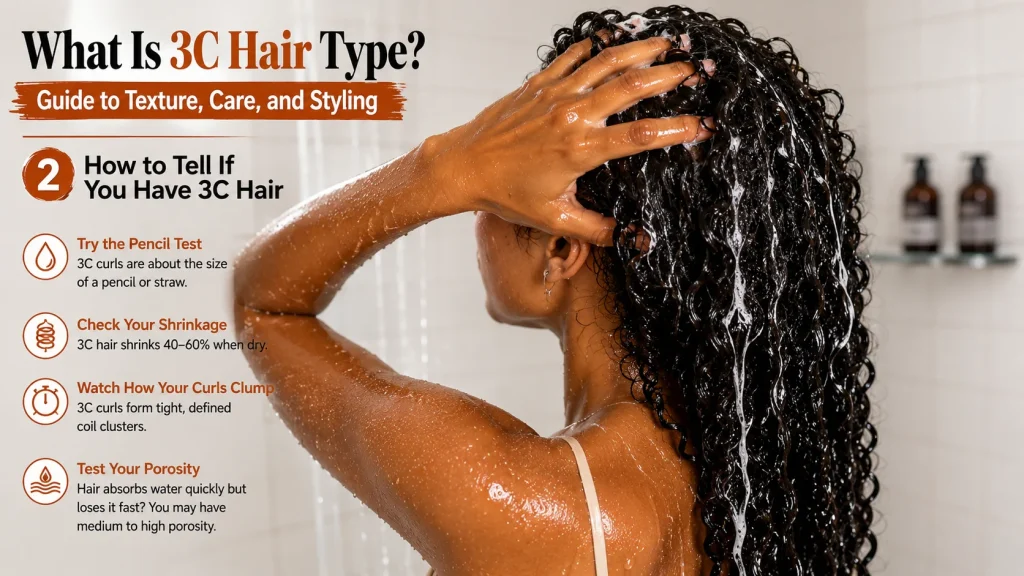
The most reliable way to identify 3C hair is to look at a single wet curl with no product in it. Let your hair air dry without touching it, then compare what you see against a few simple tests.
Try the pencil test. Hold a pencil next to one of your dry curls. If the curl coils tightly around the pencil or closely matches its diameter, you’re looking at 3C. Larger, looser loops point to 3B. Tighter, angular coils that don’t form a round spiral point toward 4A.
Check your shrinkage percentage. 3C hair shrinks 40-60% when dry. If your hair reaches your shoulders when wet but only hits your chin when dry, that shrinkage range is consistent with 3C curl behavior. Less than 40% often means a looser pattern; more than 60% usually signals 4A territory.
Watch how your curls clump. 3C curls naturally group into defined, small coil clusters, especially when wet. If your curls form distinct round coils without much product, that’s a strong 3C indicator.
Test your porosity. Many people with 3C hair have medium to high porosity, meaning the hair absorbs water quickly but loses it just as fast. Drop a clean, product-free strand into a glass of room-temperature water. If it sinks within two to three minutes, you likely have higher porosity hair that needs a lightweight oil or sealant at the end of your routine to hold in moisture.
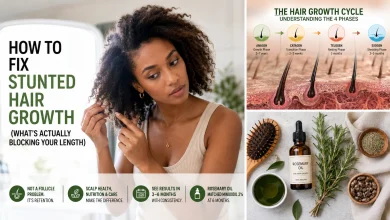
If you’re also noticing your hair is not growing as fast as expected, the issue is often retention rather than growth itself. This guide on how to fix stunted hair growth explains what actually holds 3C hair back from reaching its full length.
3C Hair vs Other Curl Types: What Are the Real Differences?
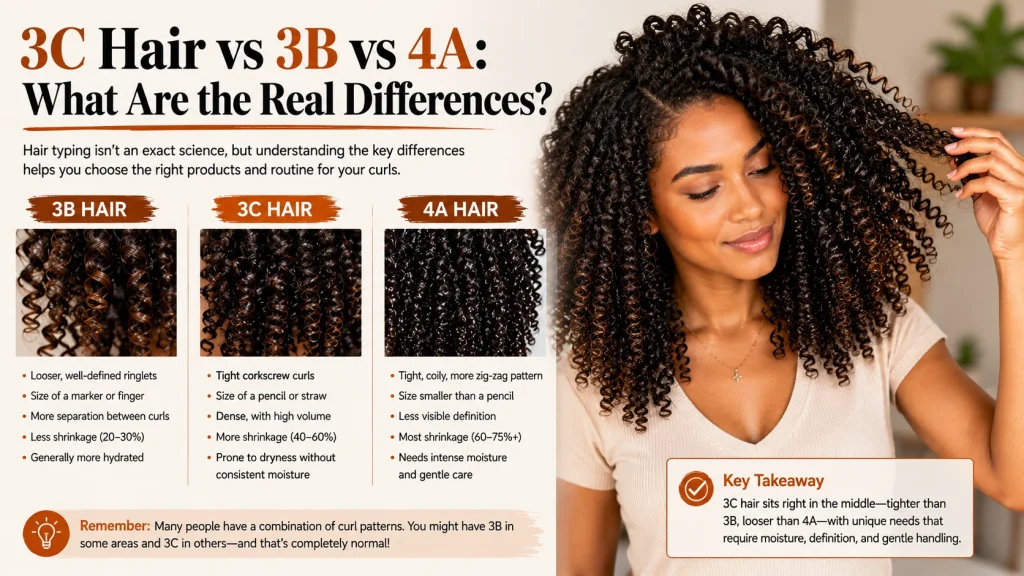
Understanding 3C vs other curl types makes it much easier to choose the right routine and products. People often confuse 3B 3C hair because the patterns are close, and the line between 3C and 4A is also genuinely blurry for many people. Here is how to tell them apart.
3B vs 3C Hair
3B hair has a wider, more open curl pattern. The ringlets are roughly the size of a large marker or finger, with clear separation between coils and less shrinkage overall. If your curls look bouncy and defined but are not tightly coiled, you’re probably a 3B.
3C curls are noticeably tighter, denser, and more spring-loaded than 3B hair. The coils are smaller, the volume is bigger, and shrinkage is more intense. When comparing 3B vs 3C hair side by side, the difference is most visible on wet, product-free hair. 3B forms loose ringlets; 3C forms tight, round spirals.
If 3B routines have not been delivering enough moisture or curl definition for you, switching to a 3C approach with richer conditioners and stronger sealants will usually solve it.
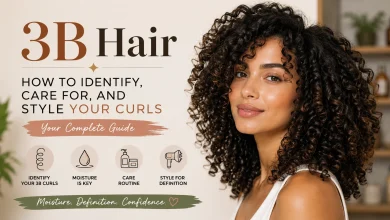
Want to see how the two compare in detail? The full 3B hair type guide covers care routine differences with practical tips for each.
3C vs 4A Hair
4A hair forms an S-shaped or tightly wound coil roughly the diameter of a toothpick or knitting needle. 4A tends to be drier and more fragile than 3C, and the coil shape is more angular rather than circular.
The clearest difference when comparing 3C vs 4A hair: 3C coils are round and spiral-shaped. 4A coils have a flatter, S-shaped movement. Wet your hair and watch how it dries without product. Round, bouncy springs point to 3C. Flat S or Z coils point to 4A.
3A vs 3C Hair
When looking at 3A vs 3C hair, the gap is even larger than 3B vs 3C. 3A hair has a loose, wide S-shaped wave with large, open ringlets. It needs light moisture and minimal product. 3C is two full steps tighter, with dense corkscrew coils and much higher moisture needs. A routine that works beautifully for 3A hair will typically leave 3C hair frizzy and under-moisturized.
What About 3C and 4C Hair?
People sometimes ask about 3C and 4C hair together, usually because both share high shrinkage and moisture needs. The key difference is coil shape and fragility. 4C has a very tight z-shaped coil with little to no visible curl pattern when dry, much higher porosity, and greater fragility than 3C. They require similar product philosophies (moisture first, sealing always) but 4C needs heavier butters and more protective handling overall.
Quick comparison across 3A 3B 3C and 4A:
| Feature | 3A | 3B | 3C | 4A |
|---|---|---|---|---|
| Curl size | Large S-wave | Wide ringlet | Pencil or straw coil | Toothpick coil |
| Shrinkage | 10-20% | 20-40% | 40-60% | 60-75% |
| Porosity tendency | Low | Low to medium | Medium to high | High |
| Moisture need | Low to moderate | Moderate | High | Very high |
| Frizz without sealing | Low | Moderate | High | High |
It’s also worth knowing where 3C sits in the broader picture. If someone in your family has Type 2B or Type 2C hair, you’ll notice just how different the needs are between wavy and curly patterns.
Best Routine for 3C Hair
3C hair needs moisture at every single step of the routine. The tight coil structure means natural scalp oils struggle to travel down the length of each strand, which is why 3C is one of the driest curl types. Getting the best routine for 3C hair right is less about finding miracle products and more about layering moisture consistently on every wash day.
[PERSONAL EXPERIENCE] Most people with 3C hair start out using products that are too light because they worry about weighing curls down. In practice, richer conditioners and a proper leave-in conditioner create more definition and bounce, not less. Lighter products tend to leave 3C hair frizzy and dry within hours.
Cleansing
Wash one to two times per week using a sulfate-free shampoo. Sulfates strip the natural oils that 3C hair already has trouble keeping. If your scalp gets oily between wash days, co-washing with conditioner only is a gentler way to refresh without disrupting your moisture balance. Focus shampoo on your scalp and let the rinse water carry it through the rest of your hair without scrubbing the strands directly.
Deep Conditioning
Deep condition on every single wash day without exception. This is the step that keeps 3C curls from becoming brittle and losing pattern definition over time. Use a moisture-focused deep conditioner rather than a protein-heavy formula, and leave it on for 20 to 30 minutes under a shower cap before rinsing.
Leave-In Conditioner
Apply leave-in conditioner to soaking wet hair the moment you step out of the shower. This is your moisture foundation. Everything else you layer on top seals it in. Work it through in sections using a wide-tooth comb or your fingers, starting at the ends and moving upward to the roots. A wide-tooth comb is the only tool you should use on 3C hair at this stage. Fine-tooth combs and brushes break apart coil clusters.
Once your hair is fully dry and styled, a curl refresher spray on the second or third day helps reactivate your curl definition without a full wash. Scrunch a small amount of curl refresher into dry or slightly damp hair, then let it air dry or briefly diffuse.
Styling on Wet Hair
3C curls respond best when styled on soaking wet hair, not damp hair. Apply curl cream or styling gel while your hair is still dripping for the best coil definition and hold. Scrunch upward gently rather than rubbing. Rake product through from roots to ends while wet, then follow with a final scrunch to encourage the curl pattern to set.
After diffusing or air drying, wrap your hair overnight in a microfiber towel or a satin bonnet to hold moisture and reduce friction. A microfiber towel creates far less frizz than a regular cotton towel and helps retain the shape of your coils through the night.
Drying
Air dry or diffuse on the lowest heat setting. If you diffuse, keep the diffuser still while each section dries instead of moving it constantly. Constant movement disrupts coil formation and creates frizz.
Best Products for 3C Hair
You do not need a shelf full of products. You need the right ones, layered in the right order. Here are the best products for 3C hair by category and what to look for in each.
| Product | What to Look For | Why 3C Hair Needs It |
|---|---|---|
| Sulfate-free shampoo | Coco-glucoside or mild surfactants | Cleanses scalp without stripping moisture |
| Deep conditioner | Shea butter, avocado oil, or glycerin base | Restores hydration on every wash day |
| Leave-in conditioner | Water as first ingredient, medium weight | Locks in moisture as the base layer before styling |
| Curl cream | Medium to thick hold, no drying alcohols | Defines coils and adds softness without crunch |
| Styling gel | Strong flexible hold, no flaking | Sets curl pattern and fights humidity-driven frizz |
| Lightweight oil | Jojoba, argan, or sweet almond | Seals the leave-in layer so moisture does not escape |
| Curl refresher | Water-based mist with a touch of leave-in | Revives day-two and day-three curl definition |
| Microfiber towel | Soft, low-friction fabric | Dries curls without disturbing coil shape or causing frizz |
| Wide-tooth comb | Wide-spaced teeth, smooth edges | Detangles wet hair without breaking coil clusters apart |
[UNIQUE INSIGHT] For 3C hair specifically, the order of products matters as much as the products themselves. The LOC method (Liquid, Oil, Cream) tends to outperform the LCO method for tighter curl types because applying the lightweight oil before the curl cream creates a better moisture seal around each strand.
Common Mistakes to Avoid With 3C Hair
The most common 3C hair problems, including frizz, dryness, and lost definition, usually come down to a short list of repeated habits. Fixing these common mistakes to avoid makes a bigger difference than switching products.
Overwashing. Washing more than twice a week strips the natural oils that 3C hair cannot afford to lose. If your scalp produces oil quickly, co-wash between shampoo sessions rather than increasing your full wash frequency.
Brushing dry curls. Running a brush or fine-tooth comb through dry 3C hair breaks apart coil clusters and creates immediate frizz. Always detangle using a wide-tooth comb on wet, conditioned hair. Work from the ends up to the roots in small sections.
Using too much protein too often. Protein strengthens the hair shaft, but used too frequently it makes already-tight 3C strands stiff and prone to breakage. Limit protein treatments to once every four to six weeks. Limp, mushy, stretchy curls signal protein need. Dry, brittle, crunchy curls signal moisture need. They are opposite problems with opposite solutions.
Skipping leave-in conditioner. Even on humid days, 3C hair needs leave-in conditioner applied to wet hair after every wash. Without it, humidity adds moisture unevenly across the strand, creating surface frizz instead of curl definition.
Drying with a regular towel. Cotton towels create friction against the coil surface that causes immediate frizz and breaks up your curl pattern. Switch to a microfiber towel or a soft cotton T-shirt to squeeze out excess water gently without disturbing the coils.
Product overload. Using too many products at once does not add moisture. It adds weight and causes buildup that eventually makes curls limp and lifeless. A four-step approach (leave-in, lightweight oil, curl cream or styling gel, seal) covers everything 3C hair needs without overloading the strand.
Best Styling Options for 3C Hair
3C hair is one of the more versatile natural textures once you understand how it moves and sets. These styles work consistently well for tight coils.
Wash-and-go. Apply leave-in conditioner and curl cream or styling gel to soaking wet hair, scrunch gently upward, and diffuse or air dry. Once fully dry, break the product cast by scrunching a small amount of lightweight oil into the curls. This releases the hold without the crunch and leaves coils soft and bouncy.
Twist-outs. Two-strand twists worn overnight or until completely dry give 3C hair a stretched, elongated curl pattern with more visible length and definition. This is also one of the best methods for managing shrinkage when you want to show more length.
Protective styles. Box braids, flat twists, and cornrows reduce daily manipulation and protect your ends from friction and breakage. Protective styling is one of the most effective ways to retain length with 3C hair. For a detailed breakdown of why 3C hair sometimes stops seeming to grow, the guide on how to fix stunted hair growth explains the retention strategies that work best for tighter curl patterns.
Diffusing for volume. Tilt your head forward and hover the diffuser under each section without moving it. This lifts the roots while drying the coils in their natural shape, giving you maximum volume with definition rather than flat, elongated curls.
Frequently Asked Questions
Is 3C hair curly or coily?
3C hair sits at the boundary between curly and coily. The tight corkscrew formation makes it the most intense pattern in the Type 3 family, but it does not have the flat z-shaped coil structure of Type 4 hair. Most stylists classify it as curly, though it shares moisture and care needs with coily types.
Can 3C hair be fine?
Yes. Hair type describes the curl pattern, not the strand thickness. You can have fine, medium, or thick individual strands with a 3C pattern. Fine 3C hair gets weighed down more easily, so lighter leave-in conditioners and curl creams work better than thick buttery formulas that flatten the coils.
Does 3C hair need protein treatments?
Only occasionally, around once every four to six weeks. Most 3C problems come from lack of moisture. Limp, mushy, overly stretchy curls signal protein deficiency. Dry, brittle, or snapping curls signal moisture deficiency. Treating the wrong problem makes things worse, so always identify which issue you’re dealing with first.
How often should you wash 3C hair?
Once or twice a week with sulfate-free shampoo works well for most 3C types. Co-washing between sessions is fine for oilier scalps. Washing more than twice a week strips the natural oils that 3C strands already struggle to hold, which leads to dryness and reduced curl definition.
What is the difference between 3A and 3C hair?
3A hair has a loose, wide S-shaped curl with large open ringlets that need minimal moisture support. 3C is two full steps tighter, with dense corkscrew coils, heavy shrinkage, and much higher moisture needs. The routines, product weights, and styling methods for 3A and 3C are almost completely different.
Conclusion
3C hair is dense, springy, and full of personality. The curl pattern looks best when it gets what it actually needs: consistent moisture, gentle detangling with a wide-tooth comb, and a simple layered routine using leave-in conditioner, curl cream or styling gel, and a lightweight oil seal.
Start with the basics. Get your wash-day routine right first. A sulfate-free shampoo, a moisture deep conditioner, and a leave-in applied to soaking wet hair will already fix most 3C hair problems before you ever think about advanced styling products.
Once you know your curl type, it also helps to understand the full picture. The guides on 3A hair, 3B hair, Type 1C hair, and Type 2C hair show you where 3C sits in the wider curl family and make it easier to understand why your hair behaves the way it does.
Your curls already know what they want to do. Your job is just to stop getting in the way.