Type 2c hair is the most defined of the three wavy hair types. The wave starts right at your root, forms a tight S-pattern throughout the strand, and sits somewhere between a beach wave and a full curl. It looks almost curly, but it doesn’t behave like curl types do. That in-between quality is exactly what makes it tricky to manage without the right approach.
I’ve worked with a lot of 2c hair over the years, and the single biggest mistake I see is people treating it like either straight hair or curly hair. It’s neither. It has its own rules, its own frizz triggers, and its own ideal routine. Once you understand those, it genuinely gets easier.
Key Takeaways
- Type 2c waves start at the root and form a tight, defined S-pattern; the strand thickness is medium to coarse with moderate shrinkage when dry.
- Co-washing once a week preserves moisture, but you still need a clarifying shampoo once a month to prevent buildup, including mineral deposits from hard water.
- Porosity and hair shaft diameter together determine which products actually work for your specific hair. Most 2c hair leans medium-to-high porosity.
- Plopping and diffusing on low heat are the two techniques that make the biggest difference for frizz-free results.
Headline
- 1 What Exactly Is Type 2c Hair?
- 2 Does Hair Porosity Change How You Care for 2c Hair?
- 3 What Ingredients Should 2c Hair Actually Look For?
- 4 How Often Should You Wash Type 2c Hair?
- 5 How to Build a Weekly Wash Day Routine for 2c Hair
- 6 Do You Really Need a Weekly Hair Mask for 2c Hair?
- 7 How to Protect 2c Hair Overnight
- 8 Frequently Asked Questions About Type 2c Hair
- 9 Conclusion
What Exactly Is Type 2c Hair?
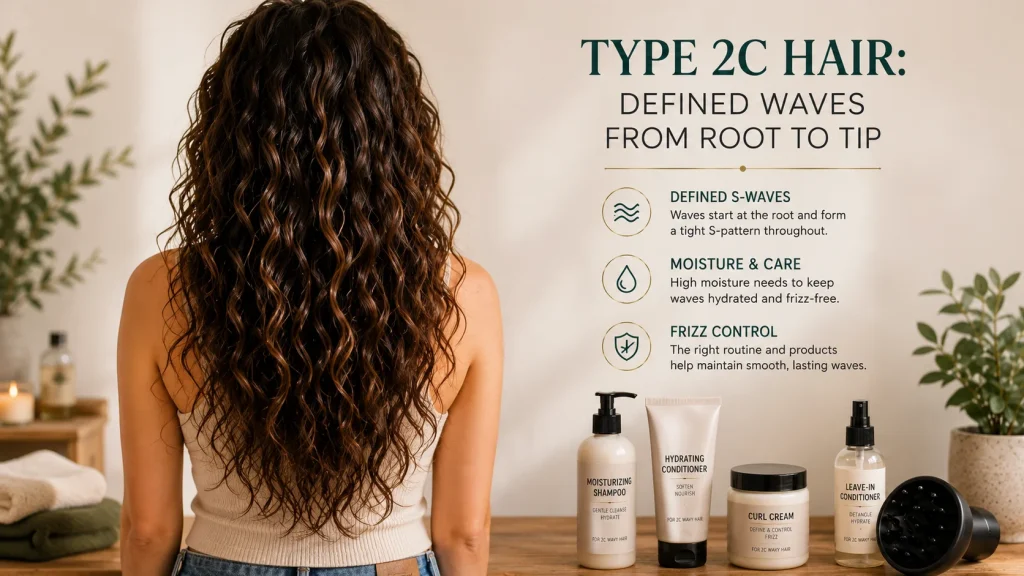
TType 2c is the third subcategory of wavy hair, and it sits right at the edge of the curl spectrum. The waves begin at the scalp rather than mid-shaft, and each strand forms a tight, somewhat thick S-shape all the way down. If you’ve ever looked at your hair wet and thought “is this curly?”, it very possibly is 2c.
The André Walker hair typing system places type 2 hair into three groups: 2a (loose, fine waves), 2b (medium waves that start mid-shaft), and 2c (tight waves from root, thicker texture). Type 2c is the densest and most frizz-prone of the three. It picks up humidity faster than 2a or 2b hair, and it needs more moisture to stay defined.
One thing most guides skip: 2c hair also has a moderate shrinkage factor. When fully dry without any manipulation, it can appear several inches shorter than its actual length. This isn’t damage, it’s just the wave contracting as moisture leaves the shaft. It’s far less dramatic than 4c shrinkage, but more noticeable than 2a or 2b. Working with wet styling techniques preserves length better than air-drying without product.
Here’s the comparison that makes the differences clear:
| Feature | Type 2a | Type 2b | Type 2c |
|---|---|---|---|
| Wave start point | Mid-shaft | Mid-shaft | Root |
| Wave tightness | Loose S | Medium S | Tight S |
| Texture | Fine to medium | Medium | Medium to coarse |
| Hair shaft diameter | Fine | Medium | Medium-thick |
| Shrinkage factor | Low | Moderate | Moderate |
| Frizz tendency | Low | Moderate | High |
| Closest curl neighbor | 1c/Bone straight | Type 2c | Type 3a |
| Moisture needs | Light | Moderate | High |
If your waves form from the root, feel somewhat thick or coarse, and frizz in humidity, you’re almost certainly 2c. If they mostly appear after drying and you have fine hair, you’re probably 2a or 2b.
Does Hair Porosity Change How You Care for 2c Hair?
Yes, and it’s probably the most important thing to understand before buying any products. Hair porosity is how well your hair absorbs and holds onto moisture, technically, it’s the rate at which water penetrates the cuticle layer. A strand with a raised or damaged cuticle absorbs water quickly but loses it just as fast; a tightly sealed cuticle resists absorption but retains moisture well once it’s in.

Low porosity 2c hair (where the cuticle stays tightly closed) needs lightweight, liquid-based products. Heavy creams sit on top of the strand rather than absorbing, which causes buildup and makes waves fall flat. The water absorption rate is slow, so heat or steam during deep conditioning helps open the cuticle enough for moisture to penetrate.
High porosity 2c hair (where the cuticle is more open or damaged) absorbs product readily but needs extra sealing. Thicker creams, butters, and oils lock moisture in after application. If your hair dries frizzy even after using conditioner, high porosity is usually why. This type also shows more visible breakage vs shedding differences: breakage snaps at any point on the shaft and leaves uneven ends, while shedding produces full-length strands with a white bulb at the root. If you’re losing mostly broken mid-shaft pieces, high porosity and moisture loss are the likely culprits.
To test yours: drop a few shed strands into a glass of room-temperature water. High porosity strands sink within two minutes. Low porosity strands float for a long time. This one test saves a lot of money on products that don’t suit your hair.
What Ingredients Should 2c Hair Actually Look For?
Type 2c hair benefits most from products built around humectants, emollients, and light proteins. Look for glycerin (a humectant that draws moisture from the air), aloe vera (hydrating and wave-defining), shea butter (seals moisture in high porosity hair), and hydrolyzed wheat protein or keratin for strength and elasticity.
The glycerin and dew point question is worth understanding properly. Glycerin works by pulling moisture from the surrounding air into the hair shaft. Whether that’s a good thing depends entirely on how much moisture is actually in the air, measured as dew point.
| Dew Point Range | Humidity Feel | Glycerin Advice |
|---|---|---|
| Below 45°F / 7°C | Very dry | Avoid glycerin — it pulls moisture from your hair, not the air, causing frizz and stiffness |
| 45–60°F / 7–15°C | Comfortable | Glycerin works well; most leave-ins and gels are fine |
| Above 60°F / 15°C | Humid | Reduce glycerin in styling products — it pulls too much moisture from the air and creates frizz |
In dry climates or winter months, swap to glycerin-free formulas like SheaMoisture’s Curl Smoothie or Kinky Curly Knot Today. In moderate climates, standard glycerin-based products like the KCCC gel or Aussie Miracle Curls work reliably. In very humid summers, look specifically for “high dew point” or glycerin-free labels.
Silicones are a separate topic. Water-soluble silicones (like PEG-modified versions) are fine with regular cleansing. Non-water-soluble silicones, dimethicone being the most common, build up on wavy hair quickly and weigh waves down. If you’re co-washing exclusively, avoid these entirely because conditioner alone won’t remove them.
How Often Should You Wash Type 2c Hair?
Washing once a week is the sweet spot for most 2c hair. Daily shampooing strips the natural sebum your scalp produces, and without that oil coating the strand, waves lose their shape and frizz much faster. A week between washes gives your hair time to build up enough natural moisture to behave well.
The method that works best is co-washing, using a cleansing conditioner instead of shampoo. Co-washing conditions the scalp and strands simultaneously, preserves your wave pattern, and reduces the dry-then-oily cycle that comes with traditional shampoo. Look for a product specifically labelled for co-washing. Regular conditioner isn’t the same; it’s formulated to moisturize after cleansing, not to cleanse. If you only have regular conditioner, use it after a gentle low-poo shampoo instead.
Worth knowing: co-washing needs a monthly reset. Conditioner residue builds up on the scalp and strands over time, and that buildup flattens your waves and causes scalp irritation. Once a month, use a sulfate-based or clarifying shampoo to remove it fully, then go back to co-washing the following week.
Hard water adds another layer here. If you live somewhere with high mineral content in the tap water, calcium and magnesium are the main culprits, those minerals deposit on the hair shaft with every wash. You’ll notice it as waves that won’t define no matter what products you use, or hair that feels rough and coated even after conditioning. A chelating shampoo (like Malibu C Hard Water Wellness Shampoo) once a month removes mineral buildup that a regular clarifying shampoo can’t touch. If your water is particularly hard, a shower filter that reduces mineral content makes a noticeable ongoing difference.
Use a wide-tooth comb for detangling only when hair is wet and saturated with conditioner. A microfibre towel is far gentler than standard terry cloth, which causes friction frizz on wavy hair.
How to Build a Weekly Wash Day Routine for 2c Hair
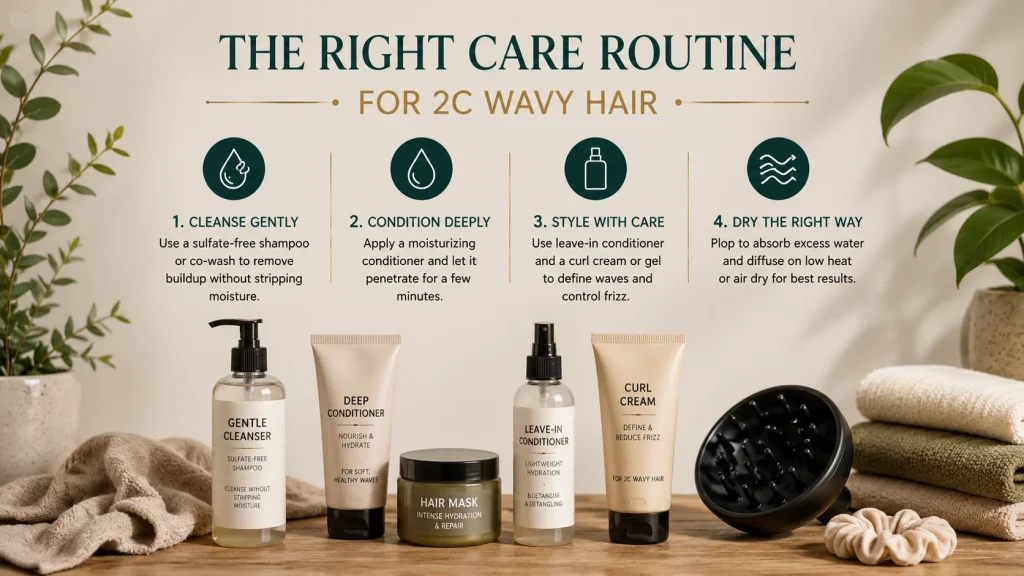
A good wash day routine for 2c hair follows a consistent sequence. The order matters because each step builds on the last.
Step 1: Detangle before you wet. Finger-detangle dry hair first, working from ends to roots. This prevents tangles from tightening under water.
Step 2: Co-wash thoroughly. Apply your cleansing conditioner to soaking-wet hair. Work it into your scalp with your fingertips in circular motions, then smooth through the lengths. Rinse well. A reliable option here is As I Am Coconut Co-Wash, which is gentle enough for weekly use without stripping.
Step 3: Apply leave-in conditioner to dripping-wet hair. Don’t towel dry first. Hair is most receptive to moisture absorption when the cuticle is still swollen and open from the water. Applying leave-in at this point maximizes how much actually penetrates the strand rather than sitting on the surface. The Kinky Curly Knot Today leave-in works especially well for 2c hair because it’s lightweight enough not to weigh waves down.
Step 4: Squish-to-condish (STC). Cup sections of your hair in your palm and squeeze upward toward your scalp. This technique encourages clumping, where individual waves group together into defined units, and reduces frizz significantly compared to smoothing product downward. The squeezing motion also pushes the leave-in deeper into the strand.
Step 5: Apply curl cream or gel. Rake or prayer-hands the product through sections while hair is still wet. Avoid touching waves once the product is in. A medium-hold gel forms a crunchy cast as your hair dries. Don’t worry about the crunch, it breaks out later. Cantu Wave Whip and Camille Rose Curl Maker are both reliable curl creams for 2c; for gel, KCCC or LA Looks Sport work well at different budget points.
Step 6: Plop for 15 to 20 minutes. Lay a microfibre towel flat, flip your hair forward onto it, and wrap the towel around your head like a turban. Plopping removes excess water gently without disrupting the wave pattern and cuts overall drying time.
Step 7: Diffuse on low heat. Hover the diffuser bowl under sections without moving it. Let each section sit in the diffuser for 30 to 45 seconds before moving to the next. Low heat and medium airflow are non-negotiable here. High heat causes frizz and disrupts the wave pattern before the gel cast fully sets. The pixie diffusing method, where you tilt your head to the side and let the diffuser cup sit still under a large section of hair, tends to give 2c hair more volume and definition than moving the diffuser continuously.
Step 8: Scrunch out the crunch (SOTC). Once your hair is fully dry and cool to the touch, scrunch firmly with your palms. This breaks the gel cast and reveals soft, defined waves underneath. Scrunching while hair is even slightly warm creates frizz instead.
Do You Really Need a Weekly Hair Mask for 2c Hair?
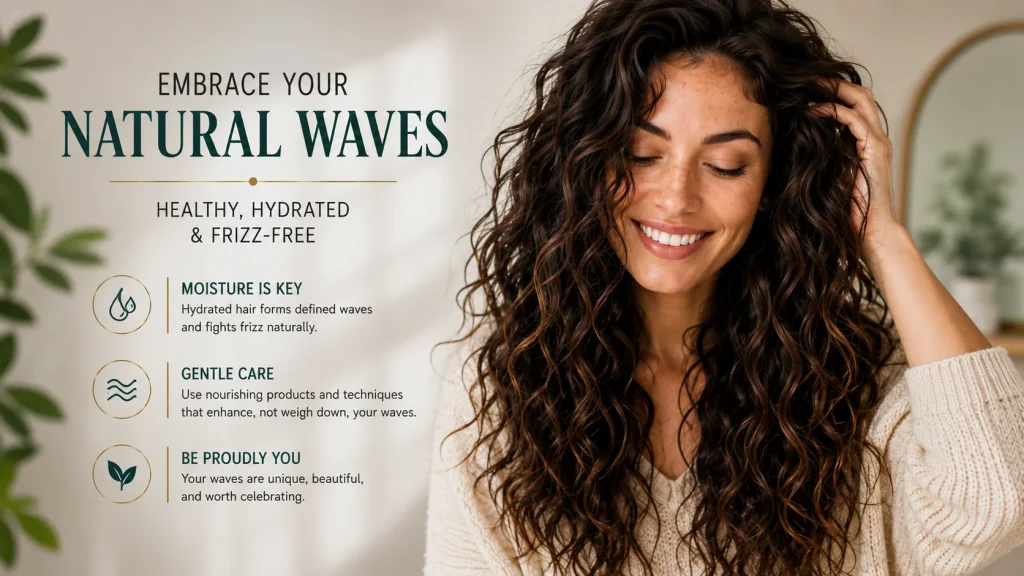
A weekly deep conditioning treatment makes a real difference for 2c hair, particularly if you use heat tools or live in a dry climate. The point isn’t just moisture it’s elasticity. Waves with good elasticity spring back after being stretched rather than breaking or going limp. Most 2c hair benefits from a deep conditioner or hair mask every 7 to 10 days.
Protein and moisture need to stay balanced. Do a wet stretch test on a shed strand. If it stretches a lot and doesn’t spring back, or feels mushy, your hair needs protein. If it snaps immediately with very little stretch, it needs moisture. Most 2c hair alternates between needing both, so checking after every few wash days helps you stay ahead of the balance. Light protein treatments every four to six weeks work well; heavy protein treatments can make waves stiff and crunchy in an unpleasant way, so use them sparingly.Second-Day
For wash day styling, the routine above covers the essentials. The product stack that consistently works best for 2c hair is: a lightweight leave-in conditioner, a curl cream with shea butter or aloe, and a medium-hold gel for cast formation. Apply in that order, always to wet hair.
If you’re using hot tools, apply a heat protectant before diffusing or reaching for an iron. Wrap sections around the barrel without clamping when using a curling iron, this preserves the natural wave shape rather than forcing a tighter curl.
For second-day and third-day hair, a refresh spray is your best tool. Mix water with a small amount of leave-in in a spray bottle (roughly 80:20 water to product). Lightly mist your waves, then scrunch gently from underneath to reactivate the curl cream already in your hair. Don’t soak the hair entirely on refresh days, it restarts the drying process and tends to create frizz rather than definition. A light mist is enough.
A final pass of light-hold hairspray or a small amount of gel on flyaways gives definition and hold without weighing waves down.
How to Protect 2c Hair Overnight
Morning frizz is almost always an overnight problem, not a product problem. When wavy hair rubs against a cotton pillowcase for seven or eight hours, the friction disrupts the wave pattern and creates frizz before you’re even out of bed.
Two things fix this reliably. First, swap your cotton pillowcase for a satin or silk one. The smooth surface generates far less friction, and your waves will look much closer to how you styled them the night before.
Second, try the pineapple method: loosely gather your hair at the very top of your head and secure it with a seamless scrunchie. This keeps waves out of the way during sleep without compressing them. In the morning, release the scrunchie, do a light mist with your refresh spray, and scrunch to reshape.
For shorter 2c lengths that don’t reach the top of the head, try multiple mini-pineapples instead: section hair into two or three loosely gathered sections and secure each one near the crown. A satin bonnet works just as well and is often easier for short 2c hair.
Frequently Asked Questions About Type 2c Hair
Is type 2c hair curly or wavy?
Type 2c is technically wavy, sitting at the top of the wavy category rather than the bottom of the curly category. The wave starts at the root and forms a tight, defined S-pattern throughout the strand. It’s often mistaken for type 3a curl because the waves are so close together, but the pattern is flatter and wider than a true ringlet curl.
What’s the difference between 2c and 3a hair?
The main difference is the shape and origin of the curl unit. Type 3a forms a full circular ringlet or spiral from root to tip. Type 2c forms a tight S-wave that lies flatter against the strand. Under a microscope, 3a strands tend to have more oval-shaped follicles, which creates the added curl. At first glance they can look similar when wet, our 2c vs 3a comparison guide goes deeper on the distinction.
Why does my 2c hair frizz so much?
The most common causes are washing too often with sulfate shampoo, drying with a cotton towel, touching waves while they’re still wet, using glycerin products in the wrong climate dew point, skipping a clarifying wash that lets silicone buildup sit on the strand, or hard water mineral deposits coating the cuticle. Fixing one or two usually makes a noticeable difference.
Can I use a regular conditioner instead of co-washing?
You can, but it’s not quite the same. Regular conditioners are formulated to moisturize after cleansing, not to cleanse. A cleansing conditioner is specifically designed to lift scalp oil and product residue while conditioning at the same time. If you only have regular conditioner, use it after a gentle low-poo shampoo rather than as a replacement for cleansing.
How do I know if I need protein or moisture?
Do a wet stretch test on a single shed strand. Hold it at both ends when wet and gently stretch. If it stretches a lot and doesn’t spring back, or feels mushy, your hair needs protein. If it snaps immediately with very little stretch, it needs moisture. Most 2c hair alternates between needing both, so checking after every few wash days keeps the balance steady.
Does the pineapple method work for short 2c hair?
For shorter lengths that don’t reach the top of the head, the pineapple method is harder to execute. Try multiple mini-pineapples: section your hair into two or three loosely gathered groups and secure each one near the crown. A satin bonnet is often the easier option for short 2c hair and works just as well for protecting the wave pattern overnight.
Conclusion
Conclusion
Type 2c hair is genuinely one of the more rewarding hair types once you crack its routine. It has real volume, real wave definition, and a texture that holds styles well when it’s healthy and hydrated. The learning curve is steeper than straight or loosely wavy hair, mostly because the products and techniques that work are more specific, and factors like porosity, dew point, and water mineral content all play into how your hair behaves day to day.
Start with the basics: co-wash weekly, clarify monthly (including with a chelating wash if you’re in a hard water area), plop before diffusing, and protect overnight. Get those four right before adding anything else.
For more on building a complete wavy hair routine, see our hair care guides including a full breakdown of type 2b hair and a guide to type 1a hair for comparison.